

You cannot build reciprocal community while running a one-woman show
On overfunctioning, child consciousness, and why the truth is the most connecting thing you can do

There is a particular kind of woman who makes community happen.
You know her. You might be her. She is the one who sends the follow-up text after the gathering, who remembers the thing you mentioned in passing three months ago and asks about it now. She reads the link you sent. She responds to the voice memo. She shows up early to help set up and stays late to help break down, not because anyone asked, but because it would feel strange not to. The circle or friend group or community runs, in no small part, because she is running it.
For a long time, she calls this love (and it is love - that part is real). But love is not the only thing accumulating.
I have been this woman more times than I can count. Not in one dramatic story but in a slow and familiar creep, the gradual realization that I am holding more of the center than anyone else, and that I said yes to holding it, and that somewhere along the way yes stopped feeling like a choice. There’s a particular exhaustion that lives in this pattern. It doesn’t announce itself loudly. It arrives as a faint, uncomfortable warmth in the chest that you don’t quite want to name.
Resentment.
Not at anyone in particular. Not even at the community itself. Just at the gap between how much you’re giving and how much is coming back. Between the version of you that keeps showing up fully and the sneaking suspicion that if you stopped, no one would notice for a very long time.
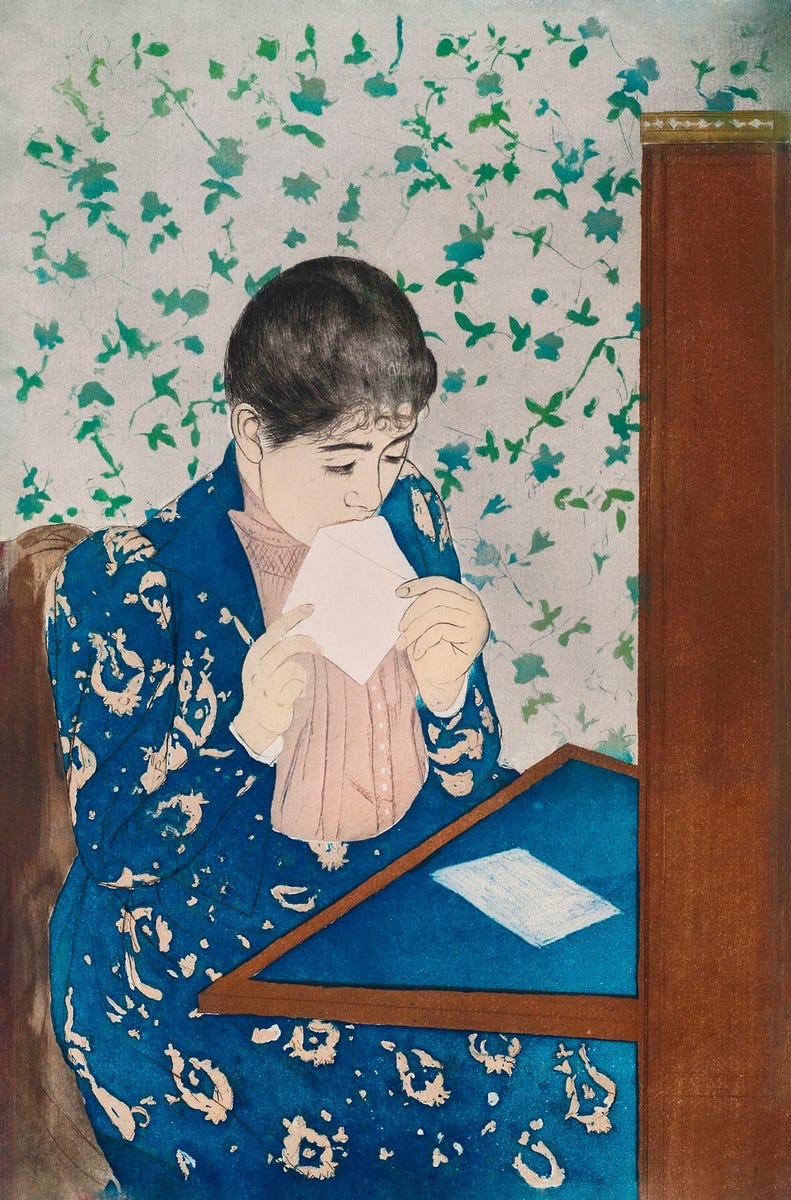
The Letter, 1890-1891 by Mary Cassatt
My friend Ginny Muir told me a story recently that I haven’t been able to stop thinking about.
Ginny is someone who, in her own words, shows up hard in community. She responds to every message, reads every link, gives her full relational attention. She was six months into a creative coven with eight women, a circle with a clear structure, shared time, reciprocal presence. And then, gradually, the structure shifted. Two women pulled back. Their schedules changed. They could only come once a month now, and everyone said the kind, understanding thing: of course, life, no worries.
But then it was Ginny’s turn to share. To be in the center and to receive the full attention of the group. And she realized, quietly and clearly, that those two women would never be there for it. Not once. And that they weren’t great at responding to her in the group thread, even though she responded to them.
She felt the resentment rise. And she recognized it, recognized the old move, the one she’d made a hundred times before: I’m fine. It’s fine. I understand. You do you.
Instead, she sent a text to the whole group.
Honest, warm, without making anyone wrong. She said: Here’s what’s real for me. She named the pattern she was trying to break, of being the one who overgives until she’s quietly seething and then either disappears without explanation or just keeps giving until she’s hollow. She proposed a new structure. She asked if they could find something that actually worked for everyone.
It was, she told me, genuinely terrifying to send. And also, it was the most adult thing she could have done.
This is the part I want to sit with for a moment, because Ginny has a framework I find both simple and deeply revolutionary in our time. She talks about child consciousness and adult consciousness, not as an insult, not as a diagnosis, just as a description of what happens inside us when we feel our belonging is at risk.
Child consciousness learned early that love is conditional on performance - on being useful, agreeable, present, easy. It learned that rocking the boat means risking the attachment, and that losing the attachment, for a small person who cannot feed or shelter herself, feels like death. So child consciousness develops strategies: brilliant, adaptive, survival-oriented strategies. Over-functioning is one of the most elegant: if I give enough, I cannot be rejected. If I am indispensable, I am safe.
We also carry these strategies into adulthood, into our friendships, into our circles, into the communities we are quite literally trying to build from scratch. And the woman who over-functions in community is almost always running this exact program, not because she’s broken, but because her gifts of attunement, care, and relational intelligence are the very same ones that made over-functioning feel, once upon a time, like love.
The resentment that accumulates isn’t a character flaw. It’s the body whispering: something is off. You are giving from fear, not from freedom.
I want to speak directly now to the women who are building things.
The ones hosting circles in their living rooms and on their farms and in rented community halls. The ones writing the emails, holding the vision, following up with the woman who went quiet. The ones who feel genuinely called to this work of gathering and tending and weaving, and who also find themselves, sometimes, exhausted in a way they can’t quite explain to anyone who isn’t doing it too.
This pattern is coming for you, if it hasn’t already. Not because you’re doing something wrong. Because the gifts that make you a community leader, your sensitivity, your follow-through, your deep belief that this kind of connection matters, are the same ones that make over-functioning feel like devotion.
And here is what I believe, after years of doing this work and watching other women do it: the most radical thing you can do for your community is learn to tell the truth inside the containers you’re building.
Not to blow them up, not to issue ultimatums, but to be the woman who sends the text. Who says, from a grounded and non-accusatory place: here’s what’s real for me. Here’s what I need in order to keep showing up freely. Because a community that requires your depletion to survive is not a community, it’s a pattern. And you cannot build a truly reciprocal community while running a one-woman show.
The version of you who can do this, who can name what isn’t working without making anyone wrong, who can hold her own needs with the same tenderness she holds everyone else’s, she is who your community actually needs. Not the woman who keeps the peace by keeping herself small. The one who tells the truth and stays.
Ginny told me that when you really include your child self, when you look back at the little one who learned to over-function and feel actual tenderness for her, not just cognitive understanding, something loosens. Possibility opens. And the adult solution, which usually turns out to be quite simple, becomes accessible.
I can just say this isn’t working for me.
To a child, those words feel impossible. They feel like the end of everything. But to an adult, they’re just the truth. And the truth, it turns out, is where real intimacy begins.
I recorded a long and rich conversation on my podcast with Ginny about all of this, about revealing the truth of who we are, about the child strategies we carry into community, about what it actually takes to feel less lonely even in a room full of people we love. It’s an excellent conversation and I think it might be exactly what we need right now.
Wow. You really came for the core gifts I’m right in the depths of discovering and naming. And my word for 2026: devotion. The good news? I’ve identified the need for truth telling. So far though, it’s still sitting heavily. May this decade be the era I step into my wisdom and my truth. Thank you for this clarion call!
Thank you for this. I am not this woman, but I think I’ve felt inadequate for not being her in the past. And it’s helpful to know that it’s not that I need to *be* her, it’s that I need to check in and see if her needs are being met too, and if she feels safe articulating them.